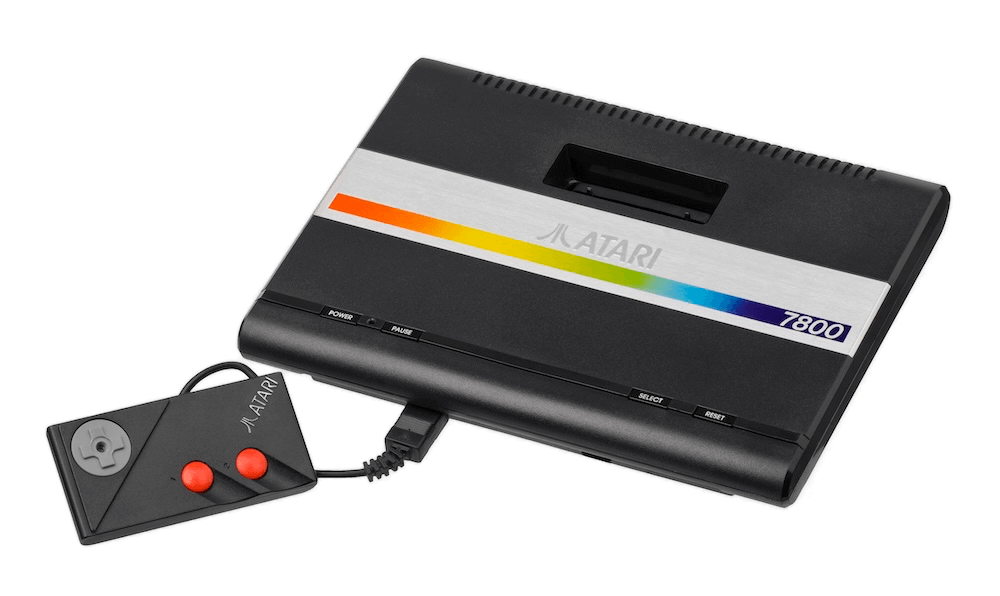
The Atari 7800 ProSystem, released in May 1986, was Atari’s attempt to rebound after the failures of the 5200 and the 1983 Video Game Crash. Originally designed in 1983 and intended for a 1984 release, the 7800 was delayed due to corporate turmoil during Atari’s sale from Warner Communications to Jack Tramiel’s Tramel Technology. By the time it launched, Nintendo’s NES was already revitalizing the home console market, leaving Atari at a disadvantage.
The 7800’s key strength was backward compatibility with Atari 2600 games, a major selling point that gave players an instant library. Its new hardware supported higher-resolution graphics and closer-to-arcade ports than previous Atari consoles. Titles such as Ballblazer, Food Fight, and Joust showcased its arcade capabilities.
However, the 7800 struggled against the NES due to limited third-party support, weaker marketing, and fewer exclusive hits. While it was a capable machine, it could not match Nintendo’s cultural momentum or developer relationships. The console sold around 3.7 million units before being discontinued in 1992.
Though not a commercial hit, the Atari 7800 is remembered as a solid system that bridged Atari’s golden age with its eventual decline in the console market. Its backward compatibility and strong arcade ports gave it a loyal niche following.
Atari 7800 Technical Specifications
| Component | Specification |
|---|---|
| CPU | Atari SALLY (6502 variant) @ 1.79 MHz |
| RAM | 4 KB main RAM, 4 KB video RAM |
| Graphics | MARIA custom chip — up to 320×240 resolution |
| Colors | 256-color palette (up to 25 on screen) |
| Sound | TIA chip (for compatibility); optional POKEY chip in cartridges |
| Media | ROM cartridges (48 KB typical, up to 144 KB) |
| Controllers | Digital joystick with two action buttons |
| Release Date | May 1986 |
| Discontinuation | 1992 |
| Units Sold | ~3.7 million |