

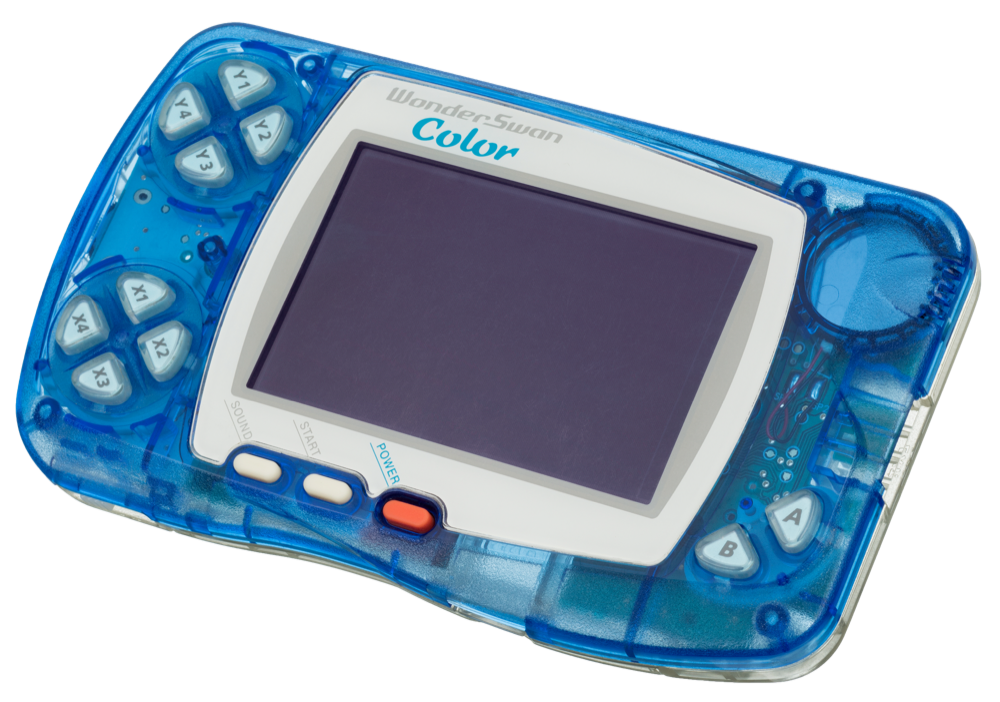
The WonderSwan was Bandai’s handheld. It launched in Japan on March 4, 1999 at ¥4,800, designed by Gunpei Yokoi’s Koto Laboratory after he left Nintendo. It never left Japan. A NEC V30 MZ ran at 3.072 MHz. Two D-pads—X and Y—let the same shell play in portrait or landscape. One AA cell lasted about 40 hours. The WonderSwan Color arrived on December 9, 2000 at ¥6,800, with a larger FSTN panel, 241 colors from 4,096, 64 KB of shared RAM, and about 20 hours on the same battery. It played the original cartridges. The SwanCrystal of July 12, 2002 swapped in a TFT screen.
The library mixed Bandai licenses with a few sharp third-party hits. Yokoi’s own Gunpey was the pack-in puzzle. Square put Final Fantasy, Final Fantasy II, and Final Fantasy IV on the Color—the first time those games sat on a handheld. Digimon Adventure, One Piece, and Mobile Suit Gundam filled the anime shelf. Namco sent Mr. Driller. Capcom and Banpresto added more.
Bandai sold about 1.55 million mono units, 1.1 million Color units, and 850,000 SwanCrystal units—3.5 million together, up to 8% of the Japanese handheld market before the Game Boy Advance arrived in March 2001. The line ended in 2003. It never beat Nintendo, but the dual grip, the battery, and that short Square list still make it the handheld people hunt for.
WonderSwan / Color Technical Specifications
| Component | Specification |
|---|---|
| CPU | NEC V30 MZ @ 3.072 MHz (16-bit) |
| Display | 224×144 FSTN LCD (WonderSwan, Color); TFT LCD (SwanCrystal) |
| Colors | WonderSwan: grayscale; Color / SwanCrystal: 241 on screen from 4,096 |
| Sound | 4-channel PCM; stereo through a headphone adapter |
| Media | ROM cartridges |
| Memory | 64 KB shared RAM (Color / SwanCrystal) |
| Battery | 1× AA; ~40 hours (WonderSwan), ~20 hours (Color), ~15 hours (SwanCrystal) |
| Controllers | Dual D-pads (X and Y) for portrait or landscape; A, B, Start |
| Release Date | March 4, 1999 (WonderSwan); December 9, 2000 (Color); July 12, 2002 (SwanCrystal) — Japan only |